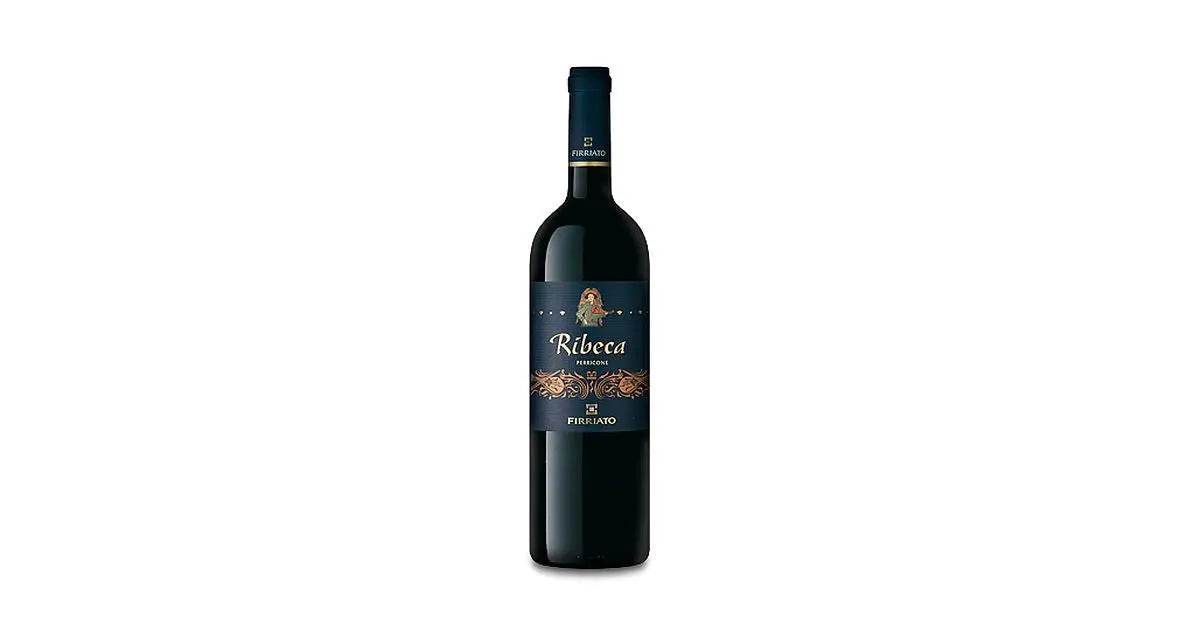
PERRICONE: THE RELLIC VINE RECOVERED BY FIRRIATO
RIBECA
Sicily D.O.C.
Perricone
Ribeca is the fruit of decades of work to recover the relic Perricone vine, of which Firriato has selected his own clone. The company believed in the qualities of this vine from the Sicilian viticultural tradition that it cultivates in the Pianoro Cuddìa estate. In this area, very dry and windy soil and climate conditions were found and Perricone found the best conditions to enhance its character. The Firriato clone interprets the varietal characteristics of a vine, once widespread, and today almost disappeared. The character of this variety manifests itself with expressions of notable elegance while the microclimate of Pianoro Cuddìa favors the aromatic complexity of the grapes and the concentration of intense but absolutely refined aromas.
CLASSIFICATION: D.O.C. Sicily VINE VARIETIES: Perricone PRODUCTION AREA: Agro di Trapani – Tenuta Pianoro Cuddìa TYPE OF SOIL: Clayey limestone EXPOSURE: South – South/West (200 meters above sea level) TRAINING SYSTEM: Counter-espalier with Guyot pruning PLANTS PER HECTARE: 5,000/6,000 YIELD PER HECTARE: 6,400 kg HARVEST: Manual harvest. 3rd week of September – 1st week of October FERMENTATION TEMPERATURE: 26°-28°C FERMENTATION PERIOD: 14 days VINIFICATION: Traditional red in thermo-controlled stainless steel tanks MALOLACTIC FERMENTATION: Breakthrough AGING: 10-12 months in French oak barriques AGING IN BOTTLE: 20 months ALCOHOL CONTENT: 14.78 % vol. | PH: 3.19 (average value) | TOTAL ACIDITY: 6.16 g/l (average value) FIRST HARVEST PRODUCED: 2000 VINTAGE PRODUCTION: 38,000 bottles FORMATS: 75 cl, 1.5 L and 3 L bottles SERVING TEMPERATURE: 18°C RECOMMENDED GLASS: Large and pot-bellied, for important wines
PRODUCTION AREA
Cuddìa plateau
The Pianoro Cuddìa estate, located in the heart of the Trapani countryside, is characterized by the compact clay of the soil which makes the cultivation of the vine complex; they are extreme soils because they are very rich in sodium.
RIBECA
Firriato's Clone
Perricone is an ancient vine from the winemaking tradition of western Sicily. The low yields and the difficulties in identifying the most suitable agronomic techniques for cultivation link the cultivation of Perricone almost exclusively to the Trapani countryside. It is a vine of difficult agronomic and oenological interpretation. Firriato interpreted Perricone by selecting from ancient vineyards scattered in the historical production areas, plants with sparser bunches and smaller grapes and with lower production yields, with the aim of maintaining high skin-pulp ratios and allowing the accumulation of anthocyanins and complex aromatic notes. The agronomic experiments and micro vinifications that have taken place over the years have identified the germplasm of a specific Firriato "clone".
RIBECA